
Grinding throughput up 2.9% from steadier circuit control
A base-metal sulphide concentrator. Autogenous grinding with recycle, closed loop.
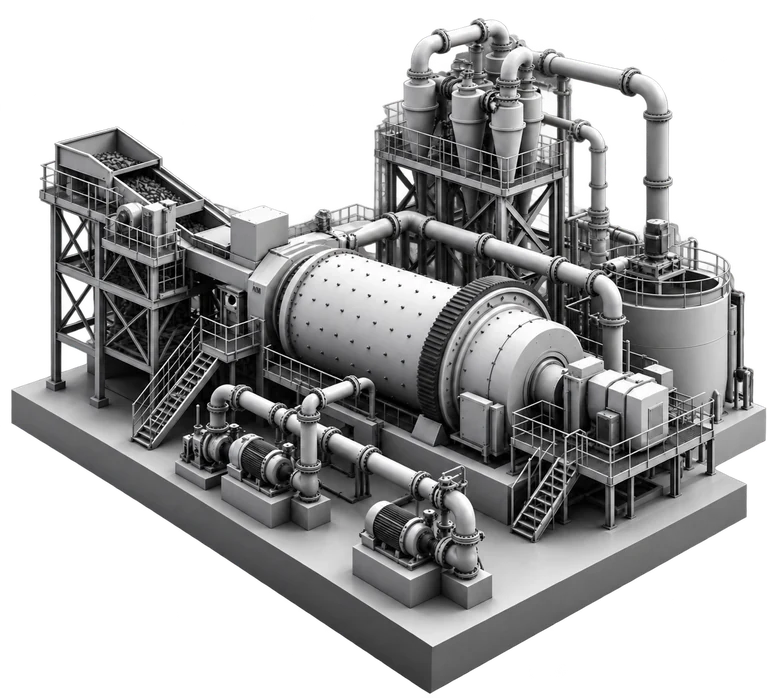
At a glance
| Commodity family | Base-metal sulphide |
|---|---|
| Circuit | Autogenous grinding with recycle |
| Control mode | Closed loop, model-predictive, with an expert-rule fallback |
| Assessment | More than a year of continuous operation |
| Comparison method | Comparison of control regimes |
The plant and the problem
Throughput on an autogenous mill is not set by the feed rate alone. Ore properties, mill charge, drive power, recirculating material and solids content all act at once, the circuit responds to any action with a delay, and its behaviour changes as ore type changes and liners wear.
Push the charge too high and the mill approaches its mass and power limits. Let it fall too low and grinding efficiency drops and the asset is underused. Swings in recirculation change the load on classification on top of that. So the problem was never to raise the feed setpoint. It was to hold the circuit in its most productive stable region, and to react to a constraint before it was reached rather than after.
What was controlled
An adaptive dynamic model was identified from plant data, capturing the non-linearity of the circuit and the delay between an action and the response. Each cycle the controller forecast the state of the circuit and chose the sequence of moves that brought charge and recirculation towards the target region without breaching a constraint.
| Manipulated | Ore feed setpoint at the feeders, mill rotation speed, and water mass flow |
|---|---|
| Controlled | Mill charge mass, main drive power, circulating load and solids content, with product sizing used to confirm quality was not traded away |
| Constraints | Upper and lower bounds on mill charge and circulating load, the drive power limit, and permitted ranges and rates of change |
| Disturbances | Ore hardness and other ore properties, the recrushing circuit, gradual change in equipment condition |
The controller ran on a ten-second cycle. Mill speed was the primary channel for controlling discharge; feed was held at its setpoint and reduced only when the charge limit came into reach; water trimmed solids content. Optimising these together stabilised recirculation as well as charge, which matters because recirculation drives the load on the classification stage that follows.
Fallback was designed in rather than bolted on. Model-predictive control ran while the forecast model held its accuracy. If accuracy dropped temporarily, for instance after an abrupt change of ore type, control transferred to an expert-rule system that does not depend on the current data distribution, so the circuit kept running under automatic control.
Results
| Metric | Baseline | With closed-loop control | Change |
|---|---|---|---|
| Mean throughput, studied circuit | — | — | +2.9% |
| Mean throughput over a full year, across ore types | — | — | +2.64% |
| Time above the upper charge limit, hard ore | 12% | 3% | −9 points |
| Time below the lower charge limit, soft ore | 25% | 1% | −24 points |
| Time below the lower circulating load limit | 11% | 2% | −9 points |
| Time above the upper circulating load limit | 7% | 0.5% | −6.5 points |
The two throughput figures cover different things and must not be added. The first is a comparison of control regimes on the circuit described here. The second is the result over a year of operation across several ore types.
How it was measured
The solution had been running continuously on this grinding section for more than a year when the result was recorded, and the constraint-time figures are drawn from that operating history, separated by ore type.
The source material does not record the exact comparison intervals, confidence intervals, or the full method for normalising against ore properties. Read the figures as the results recorded for this project, not as a controlled experiment.
What this means for your plant
The throughput did not come from simply raising the feed setpoint. It came from keeping the mill in its productive range: on hard ore it reached its upper charge limit far less often, so feed had to be cut less; on soft ore it rarely ran underfilled. If your mill is regularly backed off to protect charge or power, or runs light on softer ore, that is the same problem, and your historian will already show how much time it costs you.
See it on your own plant
A desktop review of historian exports. No site visit.